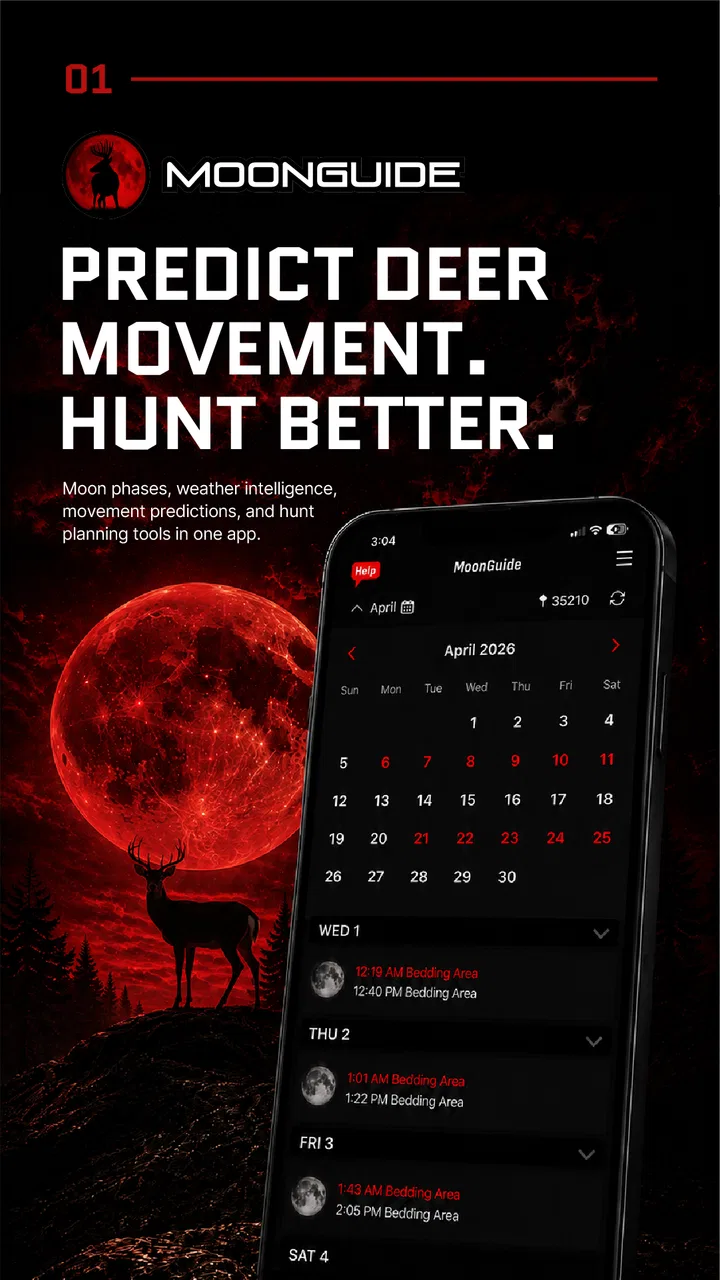
Deer Hunters MoonGuide 3.0
- 4.2
- Rating
- 50.00K
- Installs
- Free
- Price

 Analysis by App-foxy
When I first opened Deer Hunters MoonGuide, I expected a narrow hunting reference rather than a general navigation tool. That is exactly how it feels: focused, practical, and built around the relationship between the red moon and deer activity. Its store summary, “Hunt the Red Moon,” gives the right impression, but it does not explain the more important question: whether a moon-focused guide deserves a place beside the mapping and weather tools hunters already use.
My short answer is that it can, especially if you plan outings around lunar timing and want a dedicated reference instead of piecing that information together from several apps. I would not treat it as a replacement for a full map, a local weather service, or sound field judgment. I see it as a specialized layer that helps with planning. That distinction matters, because the app is most useful before a hunt, when you are comparing possible windows, rather than as a complete navigation solution once you are already outdoors.
Moonguide publishes this free Maps & Navigation app for Teen users. It has passed the fifty-thousand-install mark and holds a 4.2 average from roughly three hundred ratings, with more than a hundred written reviews. Those figures suggest a real, if still focused, user base. The app first appeared on October 19, 2020, and the current release is version 1.9.3, supporting devices running Android 7.0 or later.
You May Also Like

 Blood Strike: 2.5 Anniversary
Blood Strike’s Loadouts Turn Every Drop Into a Tactical Gamble
A close look at Blood Strike’s custom loadouts: how fast access to signature weapons reshapes its battle royale rhythm, rewards preparation, and narrows the gap between fights.

 Pandora - Music & Podcasts
Pandora’s Music Is Easy to Start, but Harder to Recover
Pandora’s strength is its low-effort path from a seed to a station. Its weak spot is how much confidence it asks you to place in connection, setup, and quiet recovery.

 8 Ball Pool
 Is Built on Rivalries, Rematches, and Routine
A close look at the rivalries, rematches, shared routines, and unanswered safety questions that turn a quick pool match into a persistent mobile community.

 Samsung Music
’s Quiet Strength Is Playing What You Already Own
Its reach comes less from spectacle than from dependable access to a personal library. That simplicity is both the app’s strongest retention engine and its ceiling.

 AccuWeather: Weather Radar
AccuWeather Review: A Quick, Clear Forecast for Everyday Decisions
For everyday plans, the best forecast is the one you can understand quickly. AccuWeather makes rain timing, radar, and local conditions easy to act on, with a few trade-offs.

 Hill Climb Racing
Why Hill Climb Racing Still Turns Crashes Into One More Run
A tiny car, a bumpy hill and one more upgrade: Hill Climb Racing keeps resurfacing because its simple chaos makes every near-miss feel personal.
More From Our News Desk
View All News


What I would check before choosing a moon-based hunting guide
The first decision is whether lunar information genuinely affects how you plan. If you simply need turn-by-turn directions to a trailhead, this is the wrong category. A conventional map app will be more useful. If you already watch moon phases, sunrise and sunset, or expected deer movement, however, a dedicated guide can make that routine quicker and easier to repeat.
I would also ask how much interpretation I want to do myself. A general astronomy app may show the moon beautifully and provide plenty of technical detail, but it may leave me to connect that information with a hunting plan. MoonGuide is more appealing when I want the hunting context to stay central. The trade-off is that a specialized tool may feel less versatile on days when I am interested in the moon for reasons unrelated to deer.
My third test is workflow. Before installing it, decide whether you want one app to provide every answer or whether you are comfortable using several tools in sequence. I normally prefer a simple preparation routine: check the likely hunting window, compare it with the conditions I expect, mark the area in a mapping app, and then make a conservative plan. A moon guide fits into that sequence, but it does not remove the need for the other steps.
The useful question is not whether the moon predicts a perfect hunt; it is whether the app helps you make a more consistent plan. I would be wary of any tool that encourages certainty from a single signal. Deer behavior is affected by habitat, pressure, food, temperature, wind, and many local factors. I use lunar guidance as one input, not as a promise of activity.
How the focused design helps during planning
The strongest idea behind this app is concentration. Instead of opening a broad weather or astronomy service and searching for the pieces that might matter to a deer hunter, I can begin with the hunting question. That saves mental effort when I am preparing several possible outings and want to compare them using the same lunar reference.
A practical way to use it is to check the app at the beginning of the week, note the windows that look worth considering, and then revisit the plan closer to the outing. I would write those observations down rather than relying on memory. That small habit prevents a common mistake: confusing an interesting lunar period with a genuinely convenient hunting day.
Another useful approach is to compare the guide with your own log. Record the date, the lunar conditions you noticed, the time spent in the field, and what actually happened. After several outings, you may find that the app helps you identify patterns that are meaningful in your area—or that local conditions consistently matter more. Either result is valuable. The app becomes a planning aid rather than an authority.
This is also where the app’s category can be misleading if read too broadly. “Maps & Navigation” suggests a tool for getting from one place to another, but the hunting use case is more about timing and orientation than full route guidance. I would install it alongside, not instead of, the navigation app I already trust for roads, trails, property boundaries, and location awareness.
Where MoonGuide is a better fit than broad alternatives
Compared with a general weather app, the appeal here is relevance. Weather services are excellent for forecasts, but they are not necessarily organized around the lunar considerations that a deer hunter wants to review. With MoonGuide, the starting point is narrower, so I spend less time translating general information into a hunting decision.
Compared with a general moon-phase or astronomy app, the advantage is audience. Astronomy apps often serve photographers, stargazers, educators, and casual observers at the same time. Their detail can be welcome, but it can also make a quick hunting check feel unnecessarily indirect. MoonGuide’s identity is easier to understand: it is meant for people thinking about deer and the red moon, not for every possible lunar activity.
Compared with paper almanacs or saved web pages, an app is easier to revisit when plans change. I can check it while adjusting a weekend schedule instead of searching through old notes. That does not make digital information automatically better, though. A printed reference is dependable when battery life or connectivity becomes a concern, and it can be easier to annotate over a long season.
The important limitation is that specialization is not the same as completeness. I would still use a mapping service for access routes and boundaries, a weather source for wind and temperature, and my own local knowledge for safety and legality. MoonGuide wins when it reduces the friction of the lunar part of that process. It loses if you expect a single download to replace every field tool.
A realistic weekend planning routine
Imagine I have a free morning coming up but several possible areas to choose from. I would first use MoonGuide to review the lunar timing associated with that morning. I would then compare the result with the weather forecast, travel time, access conditions, and any restrictions that apply to the location. If the moon looks favorable but the wind makes the stand unsafe or the route impractical, I would skip the outing rather than force the decision.
On another weekend, the lunar information might not look especially promising, but the weather and access could be excellent. I would still go if the trip made sense. That is a useful test of whether the app is helping or controlling the plan. In my view, it works best as a way to compare otherwise reasonable options, not as a reason to ignore a safe and well-prepared opportunity.
For a new hunter, this routine has an educational benefit. It encourages you to separate planning variables instead of treating “good conditions” as one vague idea. For an experienced hunter, it offers a repeatable checkpoint that can be added to an existing log. In both cases, the value comes from the habit around the app, not from tapping through it once and expecting a definitive answer.
Where other choices may fit better, and what switching really involves
I’d judge a moon-focused guide by whether it changes a planning habit for the better, not by how interesting it feels during the first few checks. When I compare alternatives, I look at which tool handles the actual decision—timing, weather, or route—and avoid adding overlap just to keep more apps installed. That makes it easier to decide whether switching would simplify your routine or merely move the same work elsewhere.
When a different app category is the smarter choice
I would choose a standard navigation app first if my main concern were finding a trail, following a route, checking my position, or sharing a destination. Those jobs require map-oriented information, and a lunar hunting guide is not the natural tool for them. The same applies if I spend more time hiking, camping, or traveling than planning deer hunts; a broader outdoor navigation product would probably earn more regular use.
A weather-first app may be better when conditions change quickly and the decision depends mostly on wind, precipitation, visibility, or temperature. In that situation, lunar context may be interesting but secondary. I would not want a moon-focused guide to distract me from a forecast that affects comfort, safety, and practical access much more directly.
An astronomy-focused app may suit someone who wants detailed sky information beyond hunting. If I were tracking celestial events, planning night photography, or learning the technical side of lunar observation, I would look for a tool designed around those goals. MoonGuide is easier to justify when deer hunting is the reason I am checking the moon in the first place.
There is also a group that should probably skip it: people who never use lunar information and do not want another planning variable. Installing a specialized app only to glance at it once is unlikely to improve a routine. The fact that it is free removes the purchase barrier, but it does not remove the cost of attention, storage, updates, and remembering which tool contains which information.
The real cost of adding it to your routine
MoonGuide costs nothing to download, which makes experimentation straightforward. There are in-app purchases listed at $24.99 per item, so I would check the purchase screen carefully before confirming anything and decide whether the free experience already covers my needs. I would not assume that every useful part of the app is included without reviewing what an optional purchase unlocks.
The bigger cost for me is workflow complexity. Each additional app creates another place to check, another interface to learn, and another chance for information to disagree. I would keep the routine deliberately small: use MoonGuide for the lunar perspective, a trusted map for location, and a weather source for immediate conditions. If that combination takes longer than the planning value it provides, I would simplify rather than keep adding tools.
Switching away later should be easy if you treat the app as a reference rather than the sole record of your plans. I recommend keeping your own notes about dates, locations, conditions, and results. That way, moving to a different moon guide, a paper calendar, or a broader outdoor app does not erase the observations that matter most to you.
Device compatibility is another practical checkpoint. The current version is 1.9.3 and the app supports Android 7.0 and newer, so owners of older phones should verify compatibility before planning around it. On a supported device, I would test the app at home, while I still have time to understand its screens and prepare a backup method for essential location information.
How I would avoid overtrusting the recommendations
The most important discipline is to treat lunar guidance as a comparison tool. I would not change a safe route, ignore a dangerous forecast, or enter unfamiliar terrain simply because the moon information looks favorable. A specialized hunting app can make one factor easier to see, but it cannot know every detail of a particular property, animal, or day.
I would also compare predictions with outcomes instead of selectively remembering successful trips. If the app points toward a promising period and the outing is quiet, that does not automatically make the app useless; it may show that another factor dominated. If a supposedly ordinary period produces a good result, that matters too. Keeping the record honest prevents confirmation bias from turning a planning aid into a superstition.
That is my main caution for beginners. The app can encourage preparation, but it should not replace learning the area, understanding local rules, respecting private property, or making a conservative decision about conditions. Those responsibilities remain with the person in the field, regardless of which navigation or hunting references are installed.
Who should install it
I would recommend trying it if you already plan deer outings around lunar timing, enjoy keeping a hunting log, or want a focused companion to your usual map and weather tools. It is particularly suitable for someone who finds broad apps cluttered and wants the moon-related part of planning presented in a hunting context.
I would be more hesitant if your needs are primarily route navigation, live weather, offline mapping, or general outdoor travel. In those cases, the app may be too narrow to become a daily tool. I would also skip it if you prefer a single all-purpose application and have no interest in comparing lunar conditions with your own field observations.
For me, the best case is modest but convincing: MoonGuide makes one specialized planning step easier without pretending to be the entire hunt. Its free entry point makes that experiment low risk, while the optional in-app purchases mean I would review the upgrade screen before spending anything. The 4.2 average and established install base give it enough credibility to test, but they do not change the need to judge it against my own routine.
My recommendation is to install Deer Hunters MoonGuide if “when should I go?” is a question you already ask in relation to the moon. Use it before an outing, compare it with weather and map information, and keep your own notes so its value can be judged over time. If what you really need is navigation, forecasting, or a complete outdoor toolkit, choose those categories first and let this app remain optional.
In the end, I see it as a focused companion rather than a universal solution. It earns its place when lunar planning is meaningful to you and when you are willing to combine it with sound judgment. That is a narrower recommendation than calling it essential, but it is also the honest one: for the right hunter, its focused approach can make preparation more deliberate; for everyone else, a broader alternative will likely do more.
FAQs for Deer Hunters MoonGuide 3.0
01What is Deer Hunters MoonGuide 3.0 used for?
Deer Hunters MoonGuide 3.0 is designed to help hunters plan outings by presenting moon-phase and lunar-position information in a practical format. It can be used to estimate periods when deer may be more active, review daily hunting conditions, and organize a schedule around sunrise, sunset, moonrise, and moonset. The app should be treated as a planning aid rather than a guarantee of animal movement or hunting success.
02Does Deer Hunters MoonGuide 3.0 require an internet connection?
The app’s basic moon-calendar and hunting-time information may be available without a continuous internet connection once the relevant data has loaded, which is useful in remote hunting areas. However, some functions can depend on location services, updated regional data, advertising content, or an occasional connection. It is best to open the app before leaving home, confirm your location and dates, and avoid relying on it as your only source of navigation or field information.
03How accurate are the hunting predictions in Deer Hunters MoonGuide 3.0?
The predictions are based on lunar cycles and related astronomical calculations, so they can be useful for comparing dates and identifying potentially favorable activity periods. They are not scientifically guaranteed forecasts of deer behavior. Weather, temperature, wind, pressure, food availability, hunting pressure, terrain, and local regulations can have an equally important or greater effect. Use the app alongside local knowledge, weather information, scouting, and responsible hunting judgment.
04What permissions and personal information does the app need?
Depending on the features and device settings, Deer Hunters MoonGuide 3.0 may request access to your approximate or precise location so it can calculate local moonrise, moonset, sunrise, sunset, and calendar information. It may also use internet access for updates or advertising. Before installing, review the permissions shown in the Google Play Store or App Store and the developer’s privacy policy. You can usually disable unnecessary permissions, although some location-based features may then be limited.
05Is Deer Hunters MoonGuide 3.0 suitable for beginners, and is it free?
The app can be useful for beginners because its main purpose is straightforward: consult lunar information and use it when planning hunting days. New users should still spend time learning what each indicator means instead of treating every rating as a definite prediction. Availability, pricing, advertisements, and optional purchases may vary by platform or region, so check the current store listing before downloading. Always verify local hunting seasons, licensing requirements, and safety rules separately.
Pros
- Clear moon-phase data helps plan deer activity around hunting dates.
- Useful sunrise
- sunset
- moonrise
- and moonset information in one place.
- Simple layout makes key hunting details quick to find outdoors.
- Can support trip planning without relying on multiple weather or astronomy apps.
- Helpful for comparing expected deer movement across different days.
Cons
- Moon predictions cannot account for local food
- pressure
- or habitat conditions.
- Some features may be less useful without accurate location permissions.
- The hunting guidance may feel basic for experienced hunters.
- Data usefulness depends on keeping the app updated and location settings enabled.
- Not a substitute for local regulations
- weather forecasts
- or hunting safety knowledge.

Deer Hunters MoonGuide 3.0
Gallery